MARLIN 2026 Game Manual
The MARLIN Robotics 2026: Link Lockdown Game Manual is the authoritative source for the game rules. This page tells you what the competition is and how to use the manual. It does not replace it.
Every release from v1.0 onwards is recorded in the manual's Change Log, and Teams are responsible for competing under the current version.
The competition
The MARLIN Robotics Competition is a maritime robotics program for students. Teams design, build, and operate unmanned surface vehicles that float, navigate, and manipulate objects on the surface of a pool. Working at the air-water interface means dealing with buoyancy, hydrodynamic drag, waterproofing, corrosion resistance, and propulsion efficiency. These are constraints that land-based robotics never has to face.
Link Lockdown is played on a 3 m × 2 m Pool by two or four Teams, each adding one Robot. Teams magnetically attach 56 floating Hex Links to Alliance Bollards of the same colour, retrieve three submerged Moorings to their Alliance Starting Area, and Berth in the central Anchorage for end-of-period position. A Match is three minutes of playtime: a 20-second Autonomous Period, then a 2-minute-40-second Driver Controlled Period, separated by an untimed Intermission Period while the referees record the Autonomous Bonus.
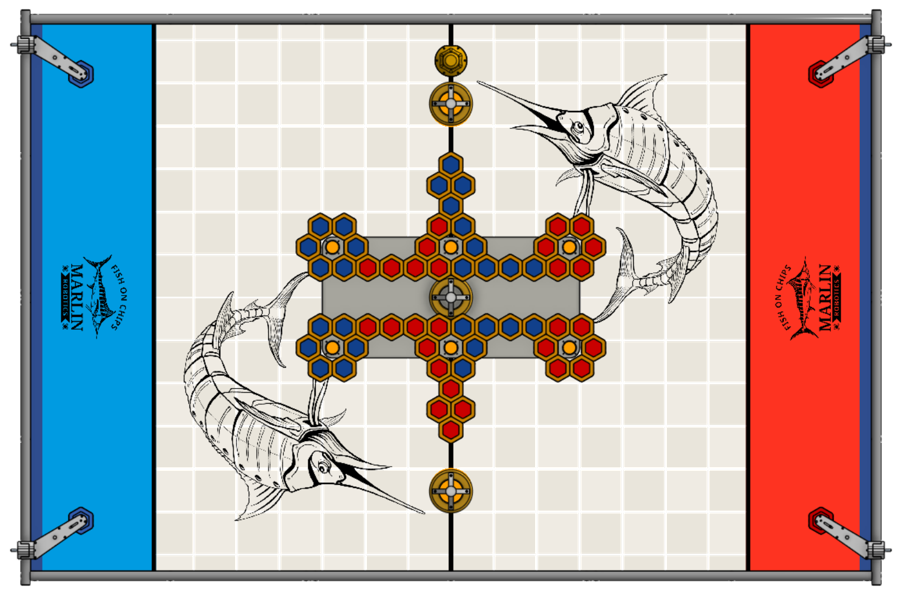
The Hex Link arrangement in that figure is decorative. The manual is explicit that Hex Links can start in any physical arrangement, so do not build an auton that assumes the pattern you see here.
Competition format
A competition is Qualification Matches first, then Elimination Matches. The two are played to different formats, and the difference changes how your Robot shares the Pool.
| Qualification Matches | Elimination Matches | |
|---|---|---|
| Format | 2-v-2 | 1-v-1 |
| Teams per Alliance | 2 | 1 |
| Alliances per Match | one red, one blue | one red, one blue |
| Robots in the Pool | 4 | 2 |
Anchorage capacity <SG5> |
3 Robots | 1 Robot |
| How many you play | at least 6 <C7> |
until you lose <C10> |
Qualification Matches
A Match Schedule is published on the day of the competition <C6>. It tells
you your Alliance partner, your opponents, your Alliance colour, which Pool you
are on, and when you play. It can change at the Event Partner's discretion, and
a Match can start early only if everyone is present and ready.
Report to your Pool on time. A Team that does not turn up punctually may have
the Match played without it, and receives a Disqualification <C6>.
Ranking
Qualification Matches decide your seed for the Elimination Bracket <C9>. Teams
are ranked on these, in order, each one breaking ties in the one above:
- Win Rate: matches won ÷ matches played
- Average Score: total points your Alliance scored ÷ matches played
- Average Schedule Difficulty Points: total points scored by the losing Alliance of each of your Matches ÷ matches played
- Highest Match Score
- Second-highest Match Score
- Random electronic draw
Schedule Difficulty Points measure how hard your Matches were. All four Teams in a Match receive the same figure, whichever Alliance won.
Elimination Matches
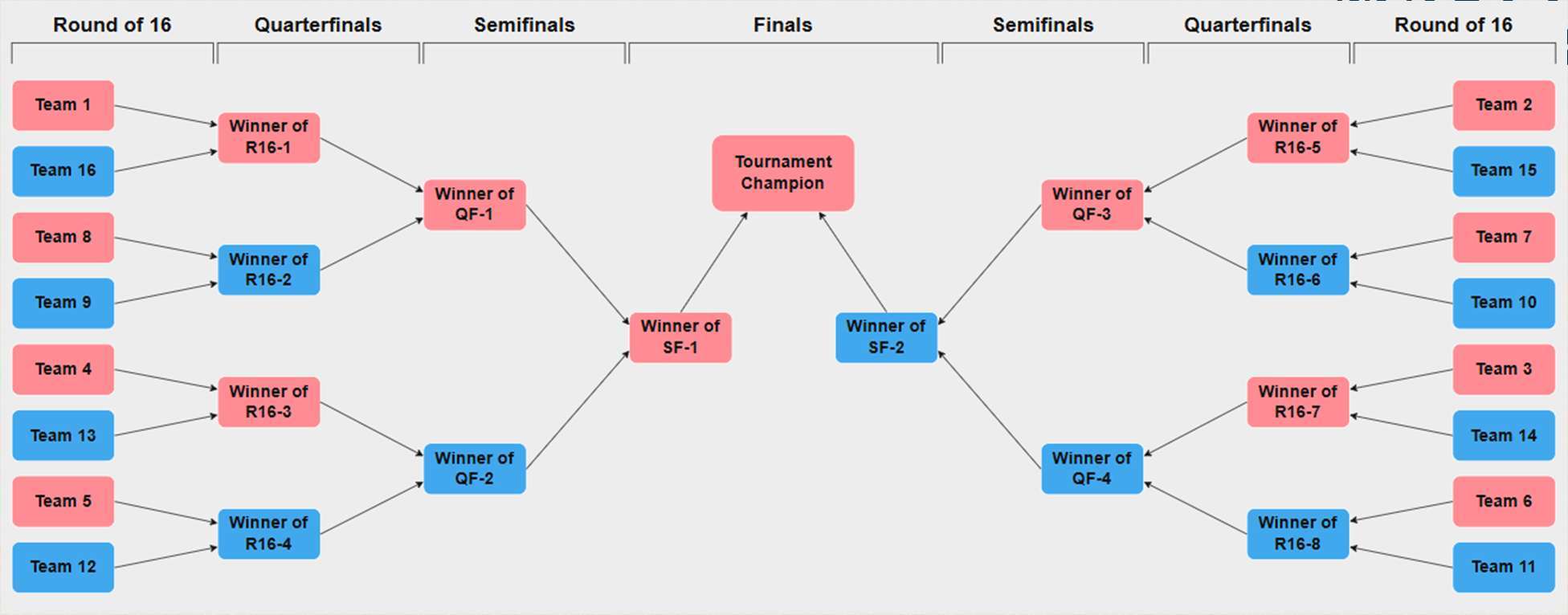
The top 16 Teams advance <C10>. They are seeded 1 to 16 by rank, and the
bracket pairs the strongest against the weakest: 1 plays 16, 2 plays 15, and so
on. It is single elimination. The winner of each Match goes through. The loser
plays no further Matches at that competition. A Team disqualified during an
Elimination Match hands the round to its opponent.
Ties and replays
Equal scores do not settle a Match on their own. <C8> breaks the tie in this
order: the Alliance without a Disqualified Team wins; then the Alliance awarded
the Autonomous Bonus Score; then the Alliance that scored the Beacon. Only if
none of those separates the two is the Match a Tie.
A tied Qualification Match is recorded as a Win for both Alliances, and both
receive the same Match Score and Schedule Difficulty Points. A tied Elimination
Match is replayed, but not indefinitely <C11>: the higher-seeded Team advances
after two ties in a normal Match, or three in a final, counting the original.
Match replays are rare and at the Head Referee's discretion <C12>. They cover
Pool or Scoring Elements starting out of position, elements moving on their own,
a period ending early, a Pool Laptop fault that Disables several Teams, and both
Teams in an Elimination Match being disqualified.
A connection problem is not grounds for a replay
<C12> is explicit that technical faults, connection issues, game rule
disputes, and environmental factors are not grounds for a replay. A
dropped Bluetooth link or a laptop that was not ready costs you the Match.
Test your setup before you are called to the Pool.
How to use the manual
The rules work together as a system of constraints. They are not meant to be read independently of one another, and many situations need logic from several places in the manual to form a correct interpretation. Read the whole manual, not just the parts that look relevant.
| Part of the manual | What it establishes |
|---|---|
| Quick Reference Guide | Every rule number and its one-line summary |
| General Definitions | What a term means in MARLIN; this beats the dictionary meaning |
| General Game Rules | Baseline conduct, eligibility, integrity, and enforcement for all Matches |
| Scoring Rules | How points are earned and evaluated |
| Specific Game Rules | What Robots and Drive Team Members may do during a Link Lockdown Match |
| Robot Rules | How Robots may be built, configured, and inspected |
| Competition Rules | How events are run and how Teams are ranked |
Blue boxes in the manual give clarification and guidance. They supplement the rules and definitions; they do not replace them.
Rules are cited by number, such as <G8>, <SC3>, and <R1>. Use those
numbers when you ask a referee a question. Start at the Quick Reference Guide to find the number,
then read the full rule and its definitions.
Read the manual
Download the Game Manual (PDF)
For the MARLIN-specific terms used across this documentation, see Competition vocabulary.