Why choose MARLIN?
MARLIN is a marine robotics platform and competition that sets up in any school, bringing students from box to boat in a single afternoon.
Near-zero infrastructure
For most schools, marine robotics was never a question of talent or curriculum. It was a question of real estate. You needed a pool, a dock or a test tank built before a single student could start. That requirement, not the difficulty of the subject, is what kept marine robotics inside universities and well-funded schools.
Not anymore with MARLIN.
Flexible deployment
The 3 by 2 metre MARLIN Pool sets up in about an hour. Filling it takes longer than building it. Nothing is plumbed. Nothing is permanent. Set it up in a school hall or ground-floor classroom, and pack it up when the term ends.
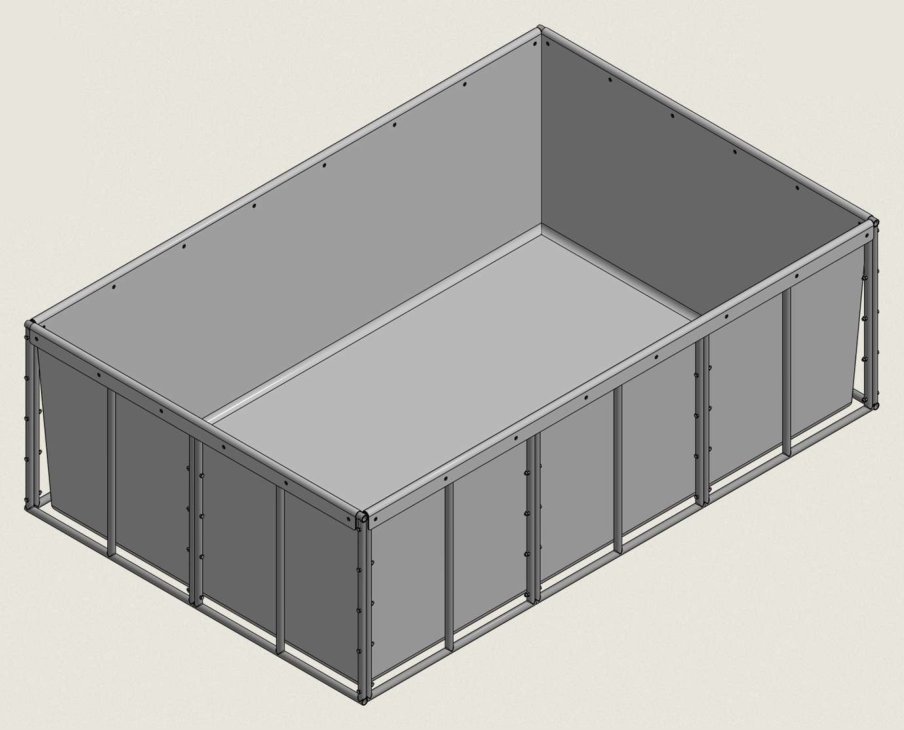
From box to water in an afternoon
A student can go from an unopened kit to their own code moving a real boat in a single afternoon.
Anywhere else, that afternoon is a term. Hulls get waterproofed by hand, enclosures get machined, and the first program runs weeks later, after work that teaches almost nothing about robotics.
Failure should be cheap
Getting something wrong should cost almost nothing. This principle shaped the platform, from part designs to programming process.
Your code runs on your laptop. The boat is a peripheral. Changing a line means editing it and pressing run, not retrieving the robot, drying it, breaking a seal, reflashing and sealing it again. A lesson becomes dozens of attempts instead of one.
Failure floats. MARLIN is a surface platform by choice. A submersible that fails sinks, and sometimes it does not come back. A MARLIN boat that fails sits on the water, waiting to be collected.
Sealing is not a student's job. The one enclosure a student opens is the brain, to change batteries, and it closes again with four screws onto a silicone face gasket that forgives a rushed team. Nothing to grease, nothing to torque, no extensive leak test before every run.
Freedom to design
Our 2026 competition game Link Lockdown asks a robot to attach 56 floating Hex Links to bollards and retrieve three submerged Moorings. MARLIN supplies no part that does either. Teams design mechanisms themselves, print it, bolt it down, and test their ideas the same afternoon. Our mechanical designs and parts are openly specified. Parts snapped? Students get to see exactly what went wrong, reprint and adapt, and it costs next to nothing in materials.
Our electronics are water-tested and deliver reliable robot performance while minimizing the cost of failure. A flooded robot brain shows students nothing and costs expensive hardware, while a broken scoring mechanism or hull is simply an invitation to iterate. Together, MARLIN provides students the space to build their wildest ideas without worrying about greasing seals and patching leaks.
Real maritime challenges
Taking away the waterproofing does not take away the engineering.
A boat has no brakes. Cut the throttle and it keeps going. It has no traction, so it drifts, yaws and gets pushed off course. There is no GPS indoors, so holding a position is a genuine control problem rather than a classroom exercise. Students meet inertia, drag and feedback as physical facts instead of equations on a whiteboard.
This is the harder robotics problem, not the easier one. Only the tedium is gone.
Test your skills and learn from peers
MARLIN is a competition as well as a platform. The 2026 season, Link Lockdown, has a published game manual and a calendar of events, so teams can expect more chances to prove themselves and get inspired by each other.
Who builds it
MARLIN is made by PolyMate, a Singapore company founded by makers, and developed in partnership with MINDEF and the Singapore Maritime Foundation. The MARLIN software was co-developed with the UR@B team from UC Berkeley.
For over two years PolyMate run a makerspace and STEM education programmes, including with MOE and SUTD.
Our vision is to make making accessible. MARLIN is that vision built for schools that were never going to get a pool.
Talk to us
Tell us about your space and your students. We will tell you whether MARLIN fits, where the pool would go, and what a first cohort could look like.